
Manufacturing Execution System
One traceable record per pipe, from coil feeding to quality certificate
A manufacturing execution system for a spiral-welded steel pipe line. It replaces paper process sheets with a single digital record for every pipe, moves work from station to station automatically, and shows the state of the line on a real-time dashboard.
Real-time dashboard
The whole line on one screen
A wall-mounted dashboard for the plant office. It answers the questions a production manager asks during a shift: what came out today, which station has stopped, and which pipe is stuck.
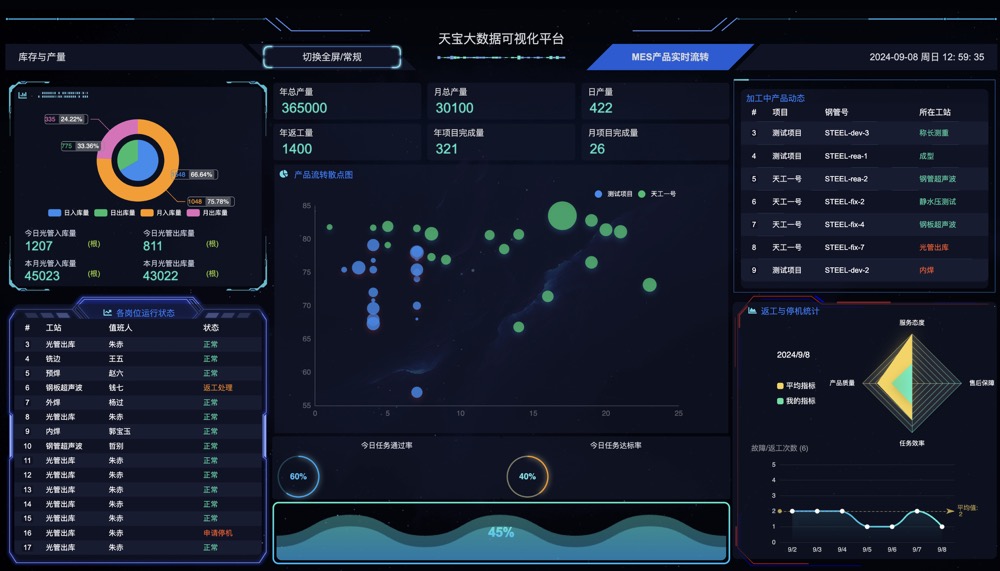
Output and inventory
Daily, monthly and yearly output, rework, completed projects and total weight, plus bare pipes moved in and out of stock today and this month.
Pipe-flow scatter
Every pipe in process, plotted by its current station and its sequence in the project. A pipe’s dot shrinks the longer it goes without an operation, so pipes that have stopped moving are easy to spot.
Station status
For each station: who is on duty, whether it is running, and its fault count and downtime in minutes for the day.
Pipes in process
A live list of pipes currently on the line, with their project, pipe number and current station.
Quality rates
Rework rate and fault rate (per thousand) and equipment availability, each shown for the month and the year.
Rework and downtime
Faults and rework for the past seven days, and this month against last month on output, faults, downtime and rework.
Two front ends, one record
The right tool for each workstation
Stations with a desk and a computer work in the browser. Stations on the shop floor use an Android app on tablets and handheld terminals. Both write to the same record for each pipe.
Web platform
Office and inspection desks
- Project setup: specification, steel grade and standard are entered once and carried to every stage.
- Inspection and test records, including ultrasonic, X-ray, hydrostatic and visual inspection.
- Product release and quality certificates at the end of the line.
- CPK quality reports (Cp, Cpk, Ca, CpL, CpU, UCL, LCL, PPM) exported to Excel with histogram and normal-curve charts, replacing charts drawn by hand every week.
- User, role and station management.
Android app
Shop-floor stations
- Each worker sees only the queue for their own station. When the upstream station finishes a pipe, it appears in the next queue automatically.
- Batch and one-click operations, and filters for the work-order list.
- Input suggestions drawn from recent entries for each field, with defaults where the value is predictable, so workers type less.
- Shift handover notes and incident reports with formatted text and photos.
Production flow
24 stages, one chain
The process sheets that used to travel with each pipe are modelled as one chain of stages. Completing a stage hands the pipe to the next one; defects found at X-ray go to repair and then rejoin the line.
- 01Material feeding
- 02Plate ultrasonic test
- 03Edge milling
- 04Forming
- 05Pre-welding
- 06Inside welding
- 07Outside welding
- 08X-ray before expansion
- 08-1 · branchRepair
- 09Mechanical expansion
- 10Hydrostatic test
- 11Rounding and straightening
- 12Pipe ultrasonic test
- 13X-ray after expansion
- 14Facing and bevelling
- 15Residual magnetism check
- 16Magnetic particle inspection
- 17Visual inspection
- 18Weighing and length measurement
- 19Bare pipe into stock
- 20Bare pipe out of stock
- 21Coated pipe into stock
- 22Coated pipe out of stock
- 23Product release
- 24Quality certificate
- DoneArchived
Hand-offs between stations run through a message queue, so a worker never waits for the next station to respond. Duplicate messages are filtered out, and a single faulty message cannot stop the flow for everyone else.
Design
Built for how the plant actually works
Requirements came from the shop floor: the plant’s paper process forms were collected on site and turned into the fields of the system. The plant runs the whole system on one server, and several design choices follow from that.
Access by station
Three roles: a single super administrator, office administrators, and shop-floor users. Each shop-floor account is bound to one station, and its menus follow that station.
Equipment integration
The marking machine and the weighing and length-measuring station exchange data with the system through signed requests. Measured length and weight cannot be edited by hand.
One server, planned for
Lightweight input suggestions instead of a search cluster, nightly precomputed totals for the dashboard, daily database backups kept for 180 days, and no database or cache ports open to the internet.